
Blackjack Insurance: Odds, Payout Rules, and When (or Whether) to Place the Insurance Bet
Authored by gicat.info, 10 Aug 2026
A dealer shows an ace, the pit falls quiet, and a small phrase gets offered to every player at the table: "Insurance?" It sounds protective, even sensible. In reality, it's one of the few side bets in blackjack with a mathematically calculable disadvantage baked into its very name - and yet millions of hands are played every day where someone takes it anyway, often on instinct rather than arithmetic.
The blackjack insurance bet has survived decades of scrutiny by professional players and mathematicians because casinos know exactly how it behaves over the long run. Dealers explain the mechanics briefly, but rarely the odds behind them. Before diving into those numbers, it helps to understand what is blackjack insurance actually represents at the table: a side wager, not a strategy adjustment, and one that operates independently from the main hand you've already committed chips to.
This piece breaks down the real probability behind the offer, the payout structure that makes it profitable only for the house in most situations, and the narrow circumstances - mostly involving card counting - where taking it can make sense. By the end, you'll know precisely when the math favors you and when it doesn't.
What Is Blackjack Insurance and How It Works
The Basic Mechanics at the Table
Insurance becomes available the moment the dealer's up-card is an ace. Before anyone acts on their hand, the dealer pauses and asks if players want to insure against a dealer blackjack. Accepting means placing a side wager, separate from your original bet, that predicts the dealer's hole card has a value of ten.
The Wager Amount and Timing
The blackjack insurance bet is capped at exactly half your original wager. If you've bet $20 on the hand, the maximum insurance wager is $10. You place this chip in a designated area on the table, usually labeled "Insurance Pays 2 to 1," and the decision must be made before the dealer checks their hole card.
What Happens After the Bet Is Placed
Once every player has decided, the dealer peeks at the hole card. If it's a ten-value card, blackjack is confirmed, insurance pays out, and the hand ends immediately for anyone without a natural blackjack of their own. If the hole card isn't a ten, the insurance bet is simply lost, and play continues as normal with the original hand still in force.
Blackjack Insurance Odds Explained
Counting the Deck for Ten-Value Cards
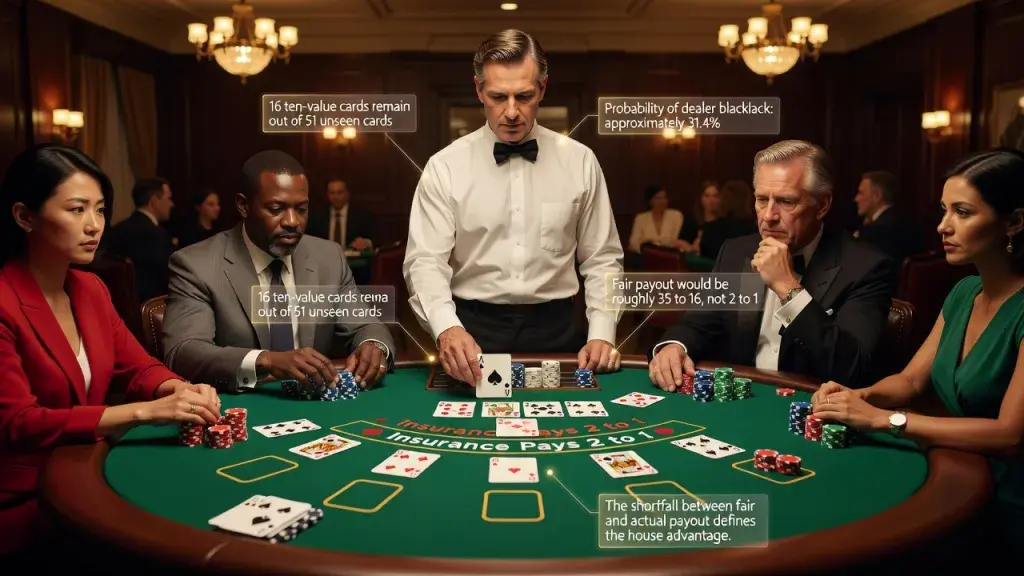
A standard deck contains 52 cards, and 16 of them carry a value of ten - the four tens plus the twelve face cards. With the dealer's ace already exposed, 51 cards remain unseen. Of those, 16 are ten-value cards and 35 are not. That ratio is the entire foundation of blackjack insurance odds.
Translating the Ratio Into Real Probability
Sixteen out of fifty-one means the dealer holds a ten-value hole card roughly 31.4% of the time in a fresh, unseen deck. The remaining 68.6% of the time, the hole card is something else, and the insurance bet loses outright. That imbalance is the crux of why the bet is unfavorable under normal conditions.
Why the Payout Doesn't Match the True Probability
For a bet to break even, the payout would need to compensate for losing roughly two-thirds of the time. A fair payout on these odds would sit closer to 35 to 16, not the 2 to 1 the casino offers. That gap between true odds and offered payout is where the house edge on insurance lives - and it's a wider edge than almost any other decision in the game.
- 16 ten-value cards remain out of 51 unseen cards
- Probability of dealer blackjack: approximately 31.4%
- Fair payout would be roughly 35 to 16, not 2 to 1
- The shortfall between fair and actual payout defines the house advantage
Blackjack Insurance Payout Rules
Standard 2 to 1 Payout Structure
Nearly every blackjack table, land-based or online, offers the same blackjack insurance payout rules: a winning insurance bet pays 2 to 1. Bet $10 on insurance, and a confirmed dealer blackjack returns $20 in winnings on top of your original $10 stake.
How Insurance Interacts With Your Main Hand
If you also hold a natural blackjack when the dealer reveals one, most tables treat this as a push on the main hand - you neither win nor lose your original bet - while the insurance side bet still pays its 2 to 1. This is the one scenario where taking insurance becomes automatic for many players, effectively locking in a profit regardless of the dealer's hole card, a maneuver often called "even money."
What Happens When the Dealer Doesn't Have Blackjack
If the hole card isn't a ten, the insurance wager is forfeited entirely, and the main hand proceeds under normal rules - you still play out your cards against the dealer's up-card as if insurance had never been offered.
Should You Take Insurance in Blackjack?
The Case Against Taking Insurance Routinely
Given a roughly 31.4% chance of the dealer holding blackjack against payout odds of 2 to 1, the math consistently favors declining the bet. Over thousands of hands, players who insure every eligible hand lose money to this side bet at a rate that outpaces almost any other decision available at the table. The answer to whether you should take insurance in blackjack, under default assumptions of a fresh shoe, is a firm no.
The Even-Money Exception
The one situation where insurance carries no risk is when you hold a natural blackjack yourself. Taking "even money" guarantees a 1 to 1 payout on your original bet instead of gambling on a push-or-win outcome. Mathematically, this is identical to taking insurance on that specific hand, and it removes variance entirely - a rare case where the emotional comfort and the statistical outcome align.
Why Casual Players Often Take It Anyway
Many players take insurance out of a desire to protect a strong hand or simply because the dealer's ace feels threatening. This instinct isn't irrational emotionally, but it isn't supported by the underlying probability either. Protecting a good hand with a bad bet doesn't change the math against you - it just adds a second losing wager to a night that might otherwise go well.
When to Buy Insurance in Blackjack
Card Counting and Deck Composition
The only scenario where the odds genuinely shift is when the remaining shoe is unusually rich in ten-value cards. Skilled card counters track the ratio of high cards to low cards throughout a shoe, and when that ratio tilts heavily toward tens and face cards, the probability of a dealer blackjack rises above the 31.4% baseline. Once it crosses roughly a third of remaining cards, the payout odds start to make sense.
Practical Thresholds for Counters
Professional counters generally look for a true count that indicates ten-value cards make up more than approximately 33% of the remaining shoe before insurance becomes a positive-expectation wager. This is a narrow and specific condition, achievable only with disciplined tracking across multiple hands, not a casual glance at the discard tray.
Why Casual Players Can't Replicate This Edge
Without an accurate running count, there's no reliable way to know whether the remaining shoe favors insurance at any given moment. Guessing based on recently seen low cards is unreliable and easily skewed by a handful of hands. This is precisely why knowing when to buy insurance in blackjack is a skill tied to counting technique, not table feel or short-term patterns.
Common Misconceptions About Blackjack Insurance
"Insurance Protects My Whole Session"
Insurance only ever protects the single hand in progress, and only against one specific outcome - a dealer natural. It has no bearing on future hands, no cumulative protective effect, and no relationship to your overall bankroll beyond that one wager.
"It's the Same as Doubling Down or Splitting"
Doubling down and splitting are strategic adjustments to your existing hand based on well-documented basic strategy charts tied to specific card combinations. Insurance is a completely separate wager with its own odds, unconnected to the strength or composition of your hand. Conflating the two leads players to misjudge how much control they actually have over the bet's outcome.
"Dealers Recommend It Because It Helps Players"
Dealers are required to offer insurance whenever an ace shows, but the offer exists because house rules mandate it, not because it benefits the player. The consistent 2 to 1 payout against worse-than-2-to-1 odds is what keeps the bet profitable for the casino over time.
Frequently Asked Questions
Is insurance the same bet every time a dealer shows an ace?
Yes, the mechanics don't change - you're always wagering on whether the hole card is a ten-value card, capped at half your original bet, paying 2 to 1 if correct. What changes is the underlying probability, which shifts with deck composition rather than with the rules of the bet itself.
Can insurance ever be a smart bet for a recreational player?
For a recreational player without a reliable count, insurance is a losing proposition in the long run because the payout doesn't match the true odds. The only exception is taking even money on your own natural blackjack, which removes risk entirely rather than adding a speculative side wager.
Why do casinos allow insurance if it's so unfavorable to players?
Casinos offer it precisely because the payout structure guarantees a house advantage over repeated play. It's a legal, transparent wager - the odds are simply stacked against the average player who takes it without tracking the shoe's composition.
Does taking insurance affect my main hand's outcome?
No, insurance is entirely separate from your main wager. Win or lose the insurance bet, your original hand still plays out under normal rules unless the dealer reveals a blackjack, which ends the hand for non-blackjack players regardless of their insurance decision.
How is "even money" different from standard insurance?
Even money is offered specifically when you hold a natural blackjack yourself, letting you accept a guaranteed 1 to 1 payout instead of risking a push. It's mathematically identical to taking insurance on that one hand, just framed differently by the dealer.
Do online blackjack games use the same insurance odds as physical tables?
Standard online blackjack games use the same 52-card single-deck logic per shoe and the same 2 to 1 payout, so the underlying probability calculations remain consistent. Multi-deck online games follow the same ratio principles, just calculated across a larger number of cards in the shoe.